
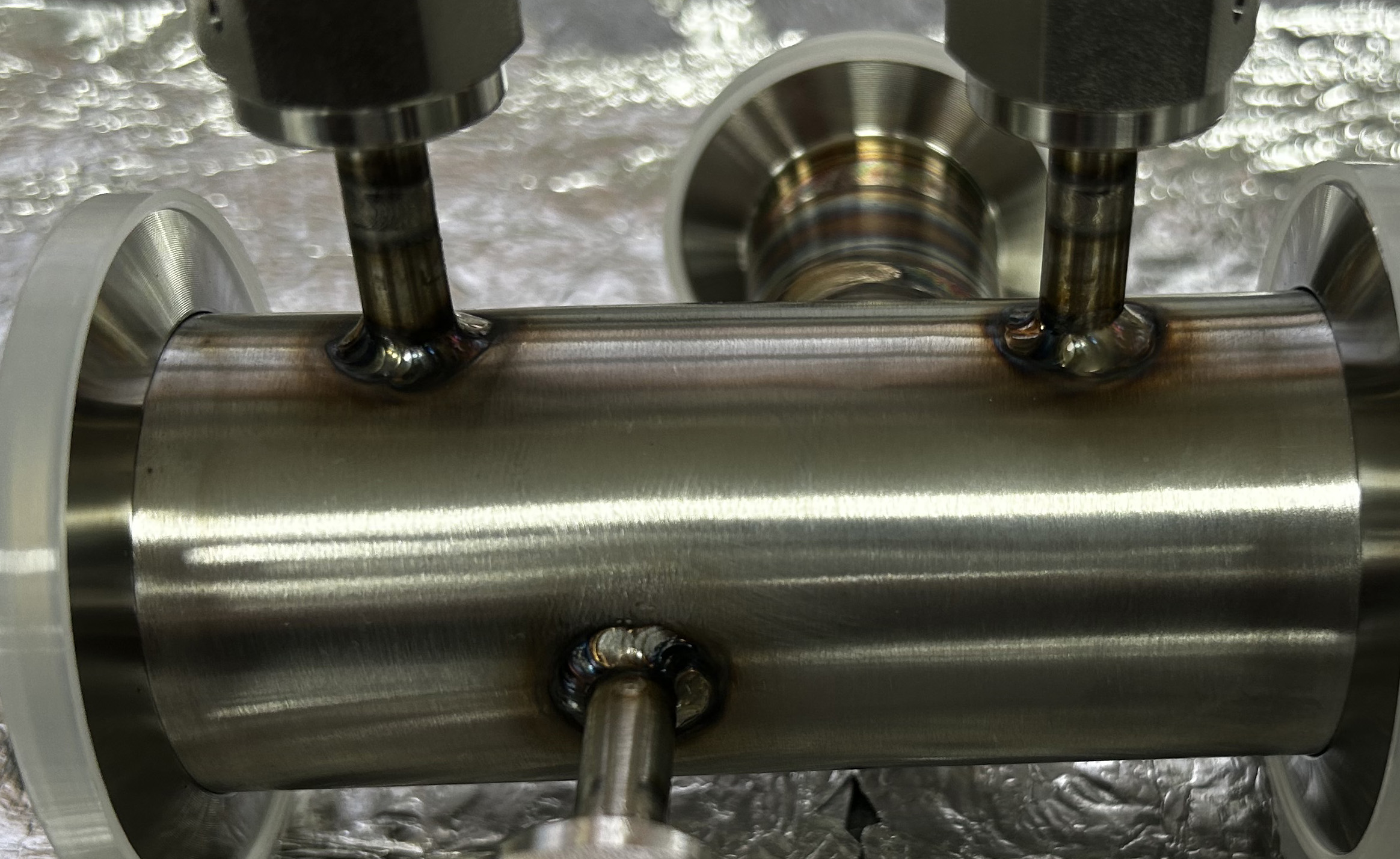
1 Basic Information
- Welding Object: VCR fitting (Outer diameter 6.3 mm / 1⁄4 inch, wall thickness 0.8 mm)
- Welding Method: Pulsed TIG
- Welding Machine Model: Panasonic YC-400TX4
- Filler Material: Stainless steel wire (diameter 0.8 mm / 1.2 mm)
- Tungsten Electrode: Diameter 2.4 mm
- Shielding Gas: High-purity Argon (≥ 99.999%)
- Back Purge: Continuous Argon protection inside the tube
2 Welding Procedure
(1) Initial Tack Weld (No Filler)
Purpose:
Create the first tack point to ensure the correct position and angle between the VCR fitting and the main tube.
Parameters:
- Current: 66 A
- Time: 0.1 s
- Mode: Spot welding (no filler)
Key Points:
Focus the arc on the edge of the joint and strictly control the duration to avoid overheating or burn-through of the thin wall.
(2) Tack Welding with Filler Wire
Purpose:
Add three additional tack points symmetrically around the joint to secure the fitting in position.
Parameters:
- Current: 66 A
- Time: 0.1 s
- Mode: Spot welding
- Filler Wire Diameter: 0.8 mm
Key Points:
Although referred to as “with filler,” no wire feeding movement is used.
A small piece of filler wire is placed at the weld area and melted by the arc to form a small molten pool.
Control the heat input to prevent oversized tacks or insufficient fusion.
(3) Full Circumferential Pulse Welding
Purpose:
Achieve complete fusion around the circumference, ensuring gas-tightness and consistent weld appearance.
Parameters:
- Peak Current: 85 A
- Pulse Width: 15
- Frequency: 1.4 Hz
- Base Current: 4 A
- Filler Wire Diameter: 1.2 mm
- Tungsten Electrode: 2.4 mm
Key Points:
- No wire feeding — the filler wire is positioned near the weld area and melted gradually by the pulsed arc.
- Keep the arc focus on the main tube, not directly on the VCR fitting, to avoid burn-through.
- Maintain smooth molten pool flow and even weld bead transition.
3 Key Process Control Points
- Backside Argon Protection:
Maintain continuous high-purity Argon flow and positive pressure inside the tube during welding to prevent oxidation or discoloration on the inner surface. - Prevent Burn-Through During Tack Welding:
Precisely control welding current and time. Always verify the stability of the parameters using test samples before production welding. - Arc Direction Control:
The tungsten electrode should be aimed toward the main tube so that the molten filler metal bridges the joint.
Do not aim the arc directly at the VCR fitting wall to avoid localized overheating. - Post-Weld Inspection:
The weld bead should be continuous and uniform, with a bright silver appearance and no signs of oxidation, discoloration, porosity, spatter, or undercut.